

Tucson rents edged higher in October 2026, continuing a gradual recovery that began earlier in the year. According to Zillow’s Observed Rent Index (ZORI), the typical rent across the Tucson metropolitan area reached $1,490, up 0.1% from September and 2.2% from a year earlier.
Although annual rent growth has improved, monthly changes remain small. For Tucson landlords, the latest figures suggest a relatively stable market where individual property characteristics, neighborhood competition, and seasonal leasing patterns remain more important than modest changes in metro-wide rents.
Tucson Rental Market at a Glance
Typical Tucson Metro Rent: $1,490
Month-over-Month Change: +0.1%
Year-over-Year Change: +2.2%
U.S. Typical Rent: $1,913
U.S. Year-over-Year Change: +2.9%
Source: Zillow Observed Rent Index (ZORI), October 2026.
Tucson Rent Trends
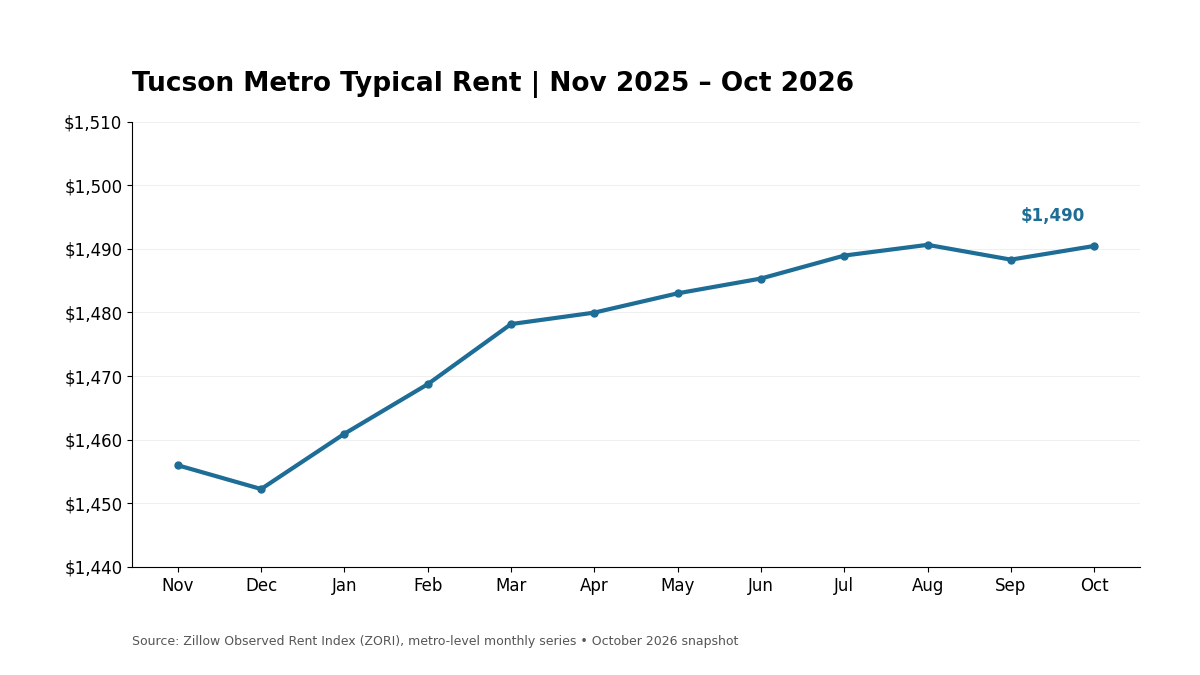
Tucson Metro Typical Rent | Nov 2025 – Oct 2026
Tucson rents have followed a gradual upward trend during much of 2026. After declining to approximately $1,452 in December 2025, the typical metro rent increased through the spring and summer, reaching approximately $1,491 in August.
September brought a small decline to $1,488, followed by a modest rebound to $1,490 in October. Despite these fluctuations, rents have remained within a narrow range over the past several months.
Annual rent growth reached 2.2% in October, compared with 2.9% nationally. Tucson continues to trail the national rate, although the difference is smaller than in Phoenix, where annual growth was 1.4%.
The broader trend indicates a measured recovery rather than rapid appreciation. Rents have improved since late 2025, but recent monthly changes offer little evidence of accelerating growth.
What Changed This Month?
October reversed September’s slight decline, but the change was modest.
The typical Tucson metro rent increased by approximately $2, from $1,488 to $1,490. Meanwhile, annual rent growth improved from approximately 1.6% in September’s published report to 2.2% in October.
That improvement is encouraging, but it should be interpreted carefully. Year-over-year comparisons reflect rent levels from twelve months earlier, and a stronger annual percentage does not necessarily mean rental demand is accelerating today.
More importantly, the past three months have shown very little movement in typical rents.
For landlords, October reinforces the importance of looking beyond a single monthly statistic. A market can experience modest annual appreciation while individual homes face considerable competition for tenants.
What Does This Mean for Tucson Landlords?
Tucson’s gradual rent recovery provides some encouraging context for property owners, but it doesn’t justify assuming every rental can command a higher asking price.
Local conditions vary considerably. A single-family home in Oro Valley may compete with a different group of properties than a rental in Rita Ranch, Marana, Sahuarita, or central Tucson. Neighborhood characteristics, property condition, amenities, and available inventory all influence what prospective tenants are willing to pay.
At Rentals America, we evaluate current comparable listings, asking prices, and leasing activity when recommending rental rates. The metro-wide average helps us understand the overall direction of the market, but it isn’t a substitute for a property-specific analysis.
As we approach the holiday season, timing also deserves consideration. Rental activity often slows during the final months of the year, although demand varies by property and location.
For owners with vacant properties, our general recommendation is to monitor inquiries and showing activity closely. When a home isn’t attracting sufficient interest, we typically recommend reassessing the asking price every 7–10 days rather than allowing unnecessary vacancy to accumulate.
For occupied properties approaching renewal, modest market growth may support reviewing the current rental rate. However, the potential benefit of an increase should be weighed against resident retention and the cost of turnover.
Related: How to Price Your Rental Property in Tucson
Tucson Rental Market Outlook
Heading into the final months of 2026, Tucson’s rental market appears relatively stable, with modest annual growth and limited recent monthly movement.
The recovery from December’s low is encouraging, but the October figures alone do not establish whether rents will continue increasing through the winter.
Seasonal leasing patterns may create additional challenges for some vacant properties, particularly when comparable rentals offer prospective tenants several alternatives. Owners should remain flexible with pricing and focus on presenting their properties competitively.
We’ll continue monitoring whether Tucson rents maintain their recent gains, resume gradual growth, or soften as the year concludes.
For additional information about housing supply, local demand, and long-term trends, explore our Tucson Rental Market Report.
Tucson Rental Market FAQ
What is the typical rent in Tucson in October 2026?
According to Zillow’s Observed Rent Index, the typical rent across the Tucson metropolitan area was $1,490 in October 2026. This is a metro-wide index and does not represent the asking rent for every neighborhood or property type.
Are Tucson rents increasing or decreasing?
Tucson rents increased 0.1% from September to October 2026 and were 2.2% higher than in October 2025. The broader trend shows modest annual growth, although monthly changes have remained small.
Should Tucson landlords increase rents in the current market?
A rent increase may be appropriate when a property’s current rent is below comparable market rates. However, owners should consider neighborhood competition, property condition, resident retention, and potential vacancy costs rather than relying solely on the metro’s 2.2% annual increase.
About the Data
Figures are based on Zillow’s Observed Rent Index (ZORI), using the Tucson metropolitan-area monthly series for October 2026. Zillow may revise historical observations as new information becomes available. Metro-level trends provide useful context, but individual rental homes and neighborhoods may experience different pricing conditions.